

To discover the Romanesque past of Gijón/Xixón.
Scattered throughout the beautiful Gijón countryside, humble and haughty at the same time, are a series of Romanesque churches that have come down to us in different degrees of primitive conservation and that, in general, present the characteristics of popular Romanesque: small size, unique nave, decorative modesty, simple structure and absence of great iconographic repertoires, which seduce the visitor by the charm of their own simplicity and by the perfect integration into the natural framework that welcomes them.
We can start our itinerary at the only temple that is located in the urban area of Gijón/Xixón: the church of San Andrés de Ceares. It stands on the left of the road that goes out to Pola de Siero, right at the top of Ceares. It is a very renovated building, although it retains its primitive Romanesque structure with its layout of a single nave and semicircular chevet, preceded by a straight section. It has a very simple façade, with no other decoration than plain mouldings. In the apse there is a window under an archivolt decorated in zigzag and supported by two columns with capitals carved with animal themes. Inside, the triumphal arch, slightly pointed, rests only on capitals, since the shafts of the columns have disappeared. They are decorated with plant motifs and hunting scenes.
It is necessary to return to the city to take the road to Villaviciosa and turn off to Deva to visit its church of San Salvador. The current construction does not allow the image of the primitive temple to be recomposed, of which only part of an arcade, the consecration tombstone and a capital of summary carving are preserved. It was a monastic church, whose foundation possibly dates back to the eleventh century, so it would be a transitional temple between the last pre-Romanesque and the most primitive Romanesque. But apart from its artistic interest, this church offers visitors the added value of its location in one of the most beautiful rural landscapes in the entire Gijón council. It is a good opportunity to approach the end of Senda del Peñafrancia, a paradisiacal space: the Güeyu Deva, a set of fountain, washing place and stone bridge.
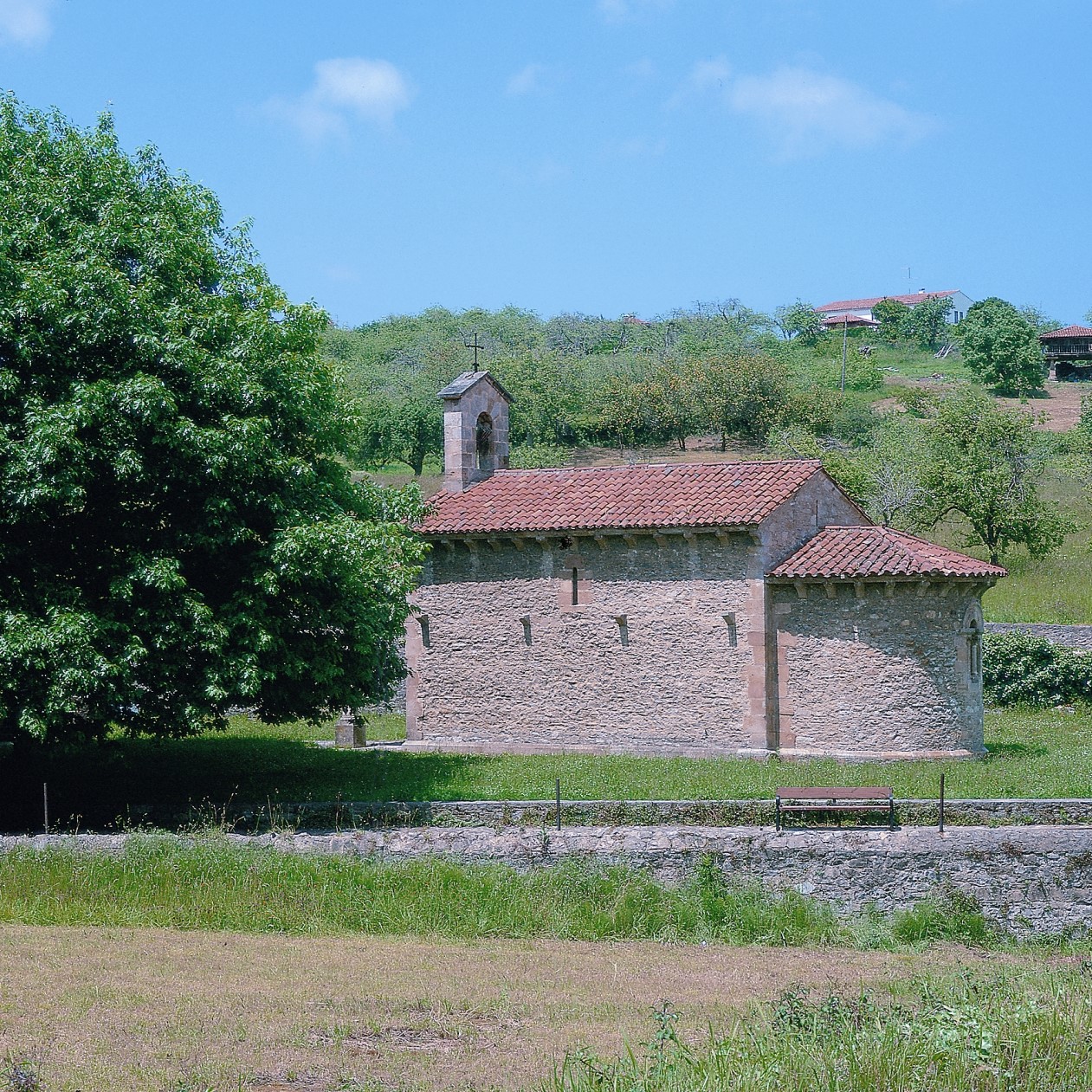
Continuing along the same road, we reach Santurio and, from there, we descend to San Miguel de Dueñas. This church, which stands in the middle of the beautiful countryside, has its greatest beauty in its humble simplicity. The restoration carried out in 1967 did not alter its primitive structure, so the visitor can get a certain idea of what a rural temple was. It is a small building, with the already known structural characteristics: a single nave and semicircular apse preceded by a straight section. The sculptural decoration is limited to the triumphal arch and, above all, to the harmonious window that opens into the apse, formed by two columns with capitals carved with plant motifs, which support a saw-toothed archivolt on an equally decorated line of imposts.
We go back to Santurio and follow the road that takes us to Caldones to stop at its parish church of San Vicente. The modifications undergone have left us with no Romanesque remains other than the façade, faithfully reconstructed. It is a simple scheme, frequently repeated within rural Romanesque: an archivolt decorated with a broken line, under a studded molding and on imposts with circular motifs. The capitals present representations of lanceolate leaves among which some heads appear.
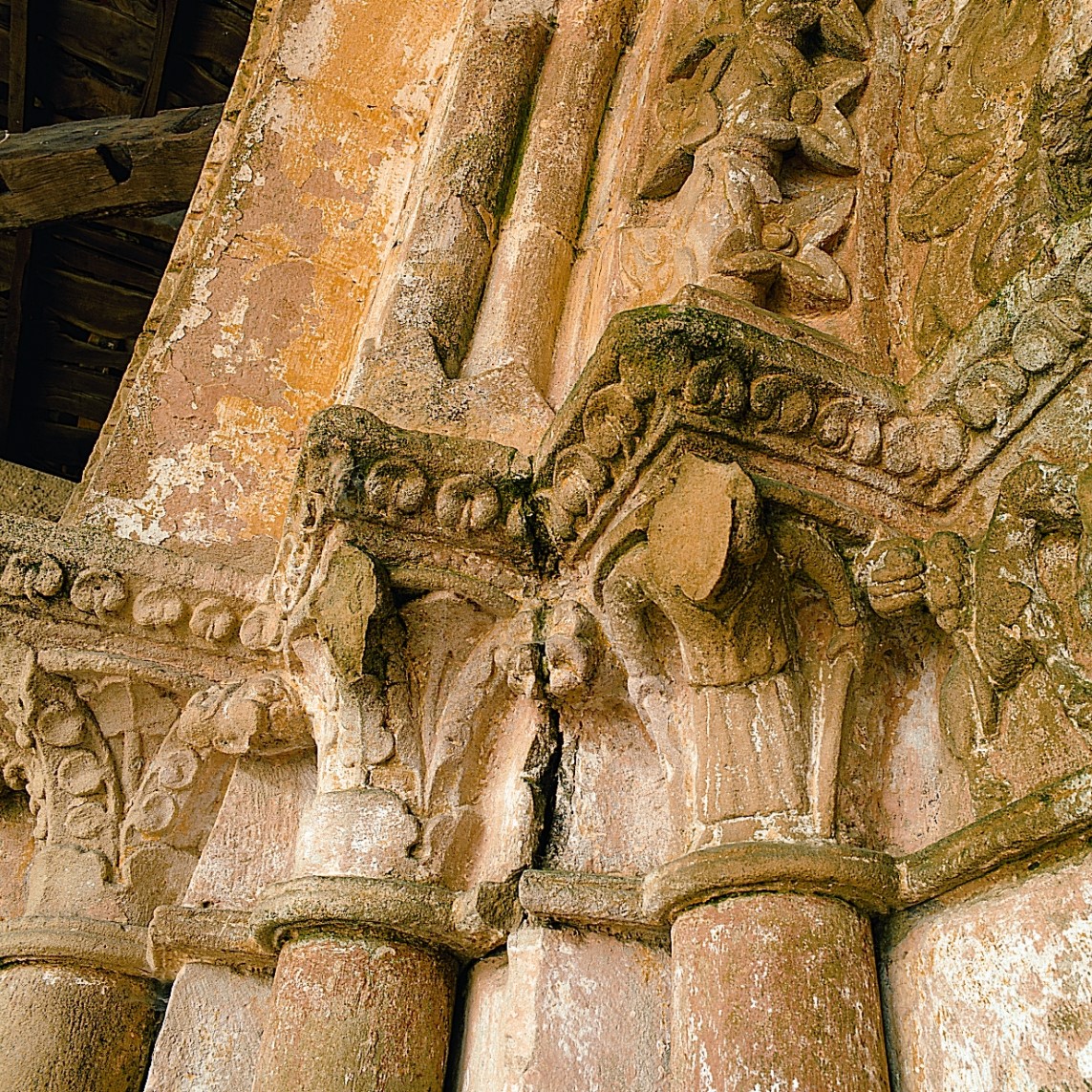
We join the AS-248 in the direction of Pola de Siero, and in Fano you will find another of the landmarks of our itinerary: the church of San Juan Evangelista. There was a Benedictine monastery here, of which we know that it already existed, at least, in the middle of the twelfth century, and of whose temple we preserve the façade, located today under a rough roof that has damaged it without any consideration. Despite its deterioration, it can still be seen that it is a façade of a certain sculptural richness, related to the nearby school of Villaviciosa and, therefore, to the so-called Romanesque cult.
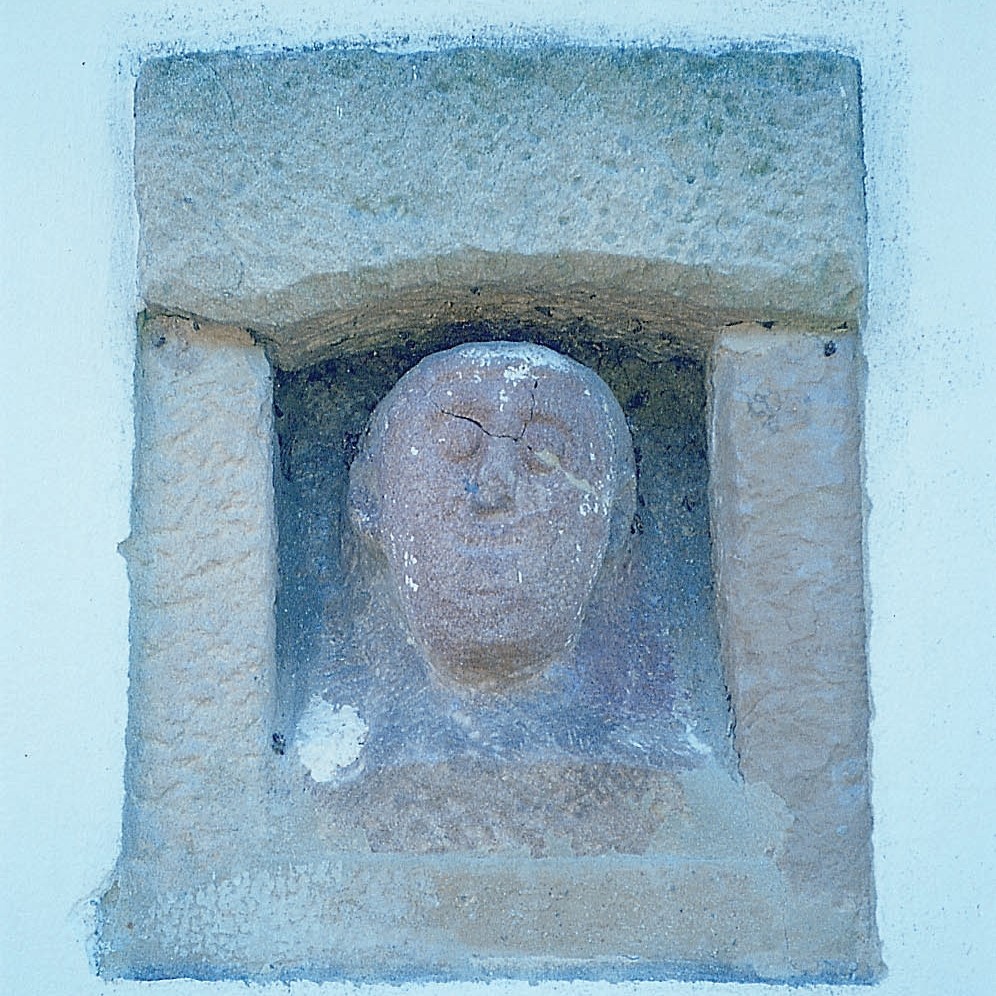
We continue along the same route and a little further on, near the limit of the council, we will pay attention to the Valdornón signpost. The atypical figure of its parish church of Santa Eulalia does not correspond at all to its Romanesque origin, of which hardly more than the capitals of the apse arch are preserved, carved with various motifs: volutes with palmette and a monstrous head on the left side, and palm leaves and a very deteriorated human figure on the right. On the outer wall of the headwall is embedded a small human head of disputed provenance.
We return to the AS-248, to Granda, to turn off towards Mareo and take the AS-246 there in the direction of El Berrón. A few kilometres away we will see the detour to Ruedes, where the church of Santa María Magdalena is located. Various sources indicate the existence in this place, in 1331, of a leper colony, of which this temple was possibly part, although, obviously, its foundation is earlier. Today it appears so disfigured that of its Romanesque origin it has only the layout of the plan, with a single nave and square head, without any decorative element. However, it is well worth a visit for the panoramic view of the Gijón countryside.
We go down again to Mareo and take the detour to La Pedrera to visit its cemetery. In the centre stands a church, converted into a pantheon, which reproduces the old temple of Santa María de Leorio, from the end of the eleventh century, and whose main artistic elements were incorporated into it. The façade and the semicircular apse are preserved. The doorway, slightly pointed, is made up of two plain archivolts, on capitals briefly decorated with plant motifs. In the apse there is a loophole under a semicircular arch, flanked by columns with carved capitals. The corbels have a shallow carving with geometric motifs.
Our next objective is Cenero. To do this, we take the direction of Sotiello and here we turn left. Soon we will see, next to a hundred-year-old yew tree, the figure of the church of San Juan Bautista. It is an old abbey temple, which is still popularly known as the abbey. The current building is the result of numerous modifications that have altered its primitive structure, both in plan and elevation, but it still retains important remains of its Romanesque character, especially the façade and the triumphal arch. The façade is made up of three archivolts with mouldings and a polylobed interior arch, which rest on capitals carved with animal and plant themes. Both the exterior moulding and the line of imposts are decorated with checkerboard. Inside, the triumphal arch appears very high and pointed, with a zigzag carved archivolt. The capitals repeat the motifs of the façade. On both sides there are two small chapels that now act more as niches. The successive modifications have respected the dimensions of the nave, which with its 17 m in length make this church the largest in the entire Romanesque of Gijón. And once again, apart from the obvious historical and artistic values of the temple, we have before us a beautiful natural corner.
The last stop on this itinerary through the Romanesque of Gijón is Serín. To get there we will cross the industrial estate of Somonte, pass under the A-8 motorway and follow the road that runs parallel to it to our destination. The parish church of San Miguel is also very modified in terms of its architectural elements, but in exchange it presents what is possibly the highest quality set of sculptural decoration of all those in the council. The three archivolts of the façade are decorated with usual motifs: broken lines, balls and peaks, but the capitals offer a theme of greater iconographic depth. They are zoomorphic representations, frequent in the medieval bestiary, which are related to the infernal world and represent vices and their punishments: birds that sting, animals with human faces, bearded monsters from whose mouths other animals come out, masks, etc. Inside, the triumphal arch also has archivolts and capitals with high quality carving and a similar theme. Overall, this walk through the Romanesque of Gijón allows the visitor not only to enjoy its countryside, but also to surrender to the seduction of an era that is still present in our council with its humble manifestations for anyone who wants to seek it.