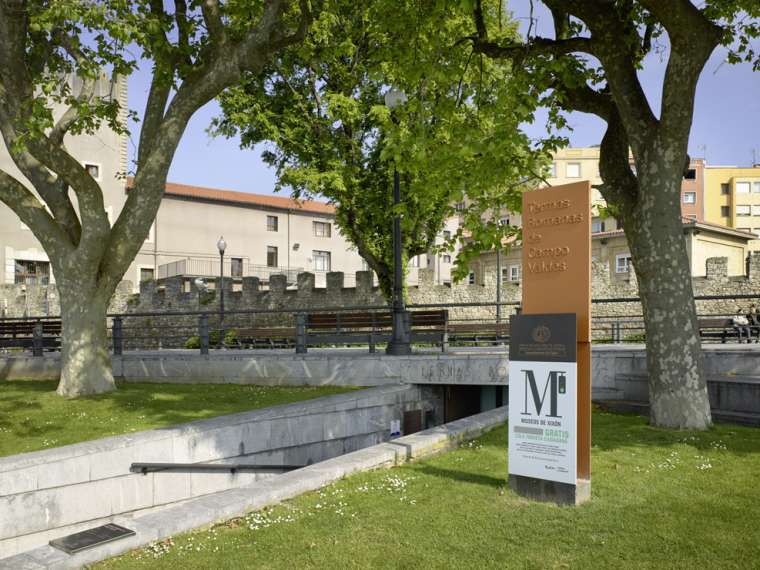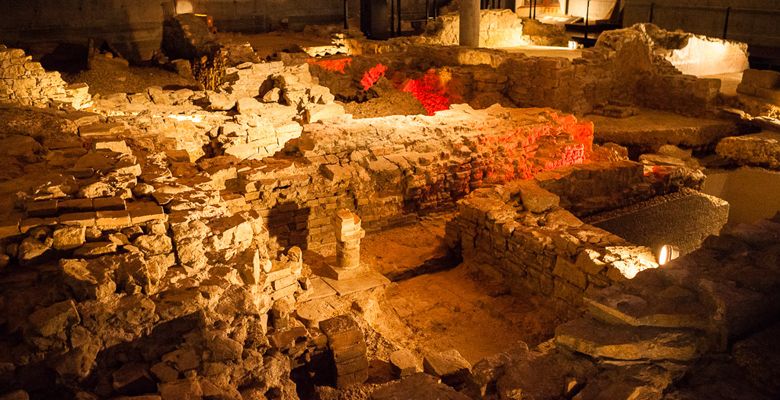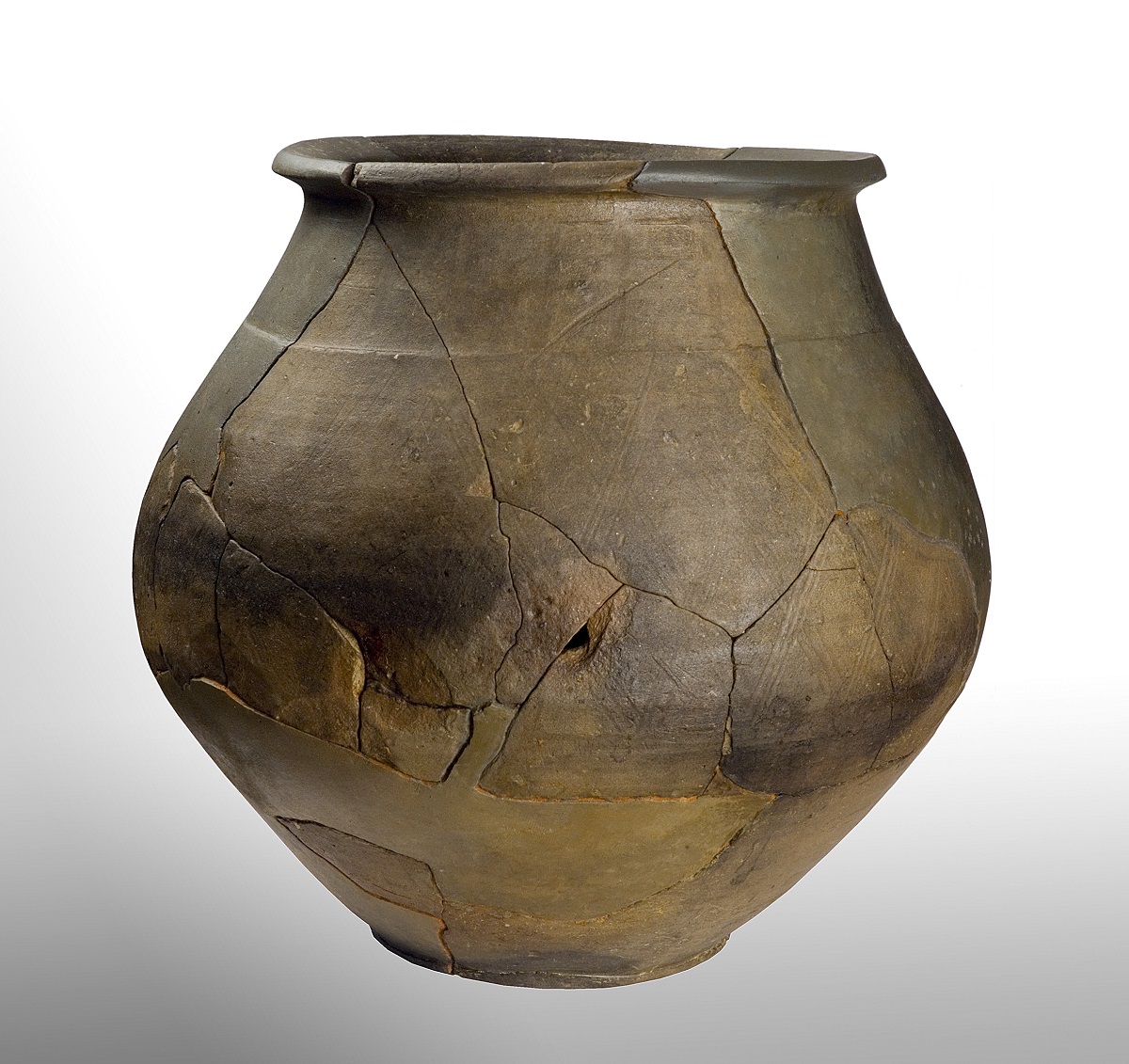

The museum of the Roman Baths of Campo Valdés, inaugurated in 1995, is a facility near the coast, located in the heart of the old city of Gijón and conceived as a site museum. A stone’s throw from the baths we will find the statue of Caesar Augustus, the great conqueror of these lands. Its main objectives are the protection, conservation, research, dissemination and didactic presentation of the remains recovered in archaeological excavations.
The visit
The visit to the museum is divided into two areas. An information area offers a complete overview of the baths in the Roman world and the operation and history of the public baths of Gijón/Xixón. A projection, models, texts and illustrative drawings indicate the functions and activities of these buildings.
The visit continues along the corridor, where a continuous display case shows the most representative archaeological materials recovered in the excavations such as construction materials, ceramics, glass, skeletal remains, etc. A model of the heating system (hypocaustum) allows you to understand how it works.
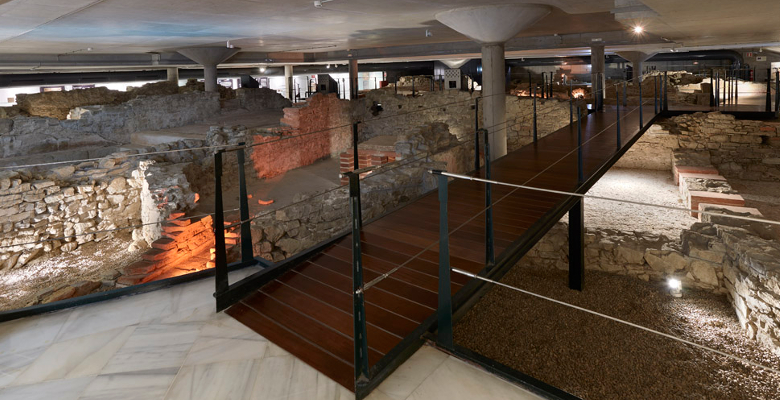
Next, the tour of the baths begins through a walkway that reproduces the interior circulation of the baths and allows you to observe the original rooms of the baths. First of all, there are the round brick columns of the sweating room. After climbing the stairs, you access the central corridor, and you can see the rooms of the first thermal building or apodyterium hall, the cold room with the frigidarium pool, the warm tepidarium room and the caldarium hot room.
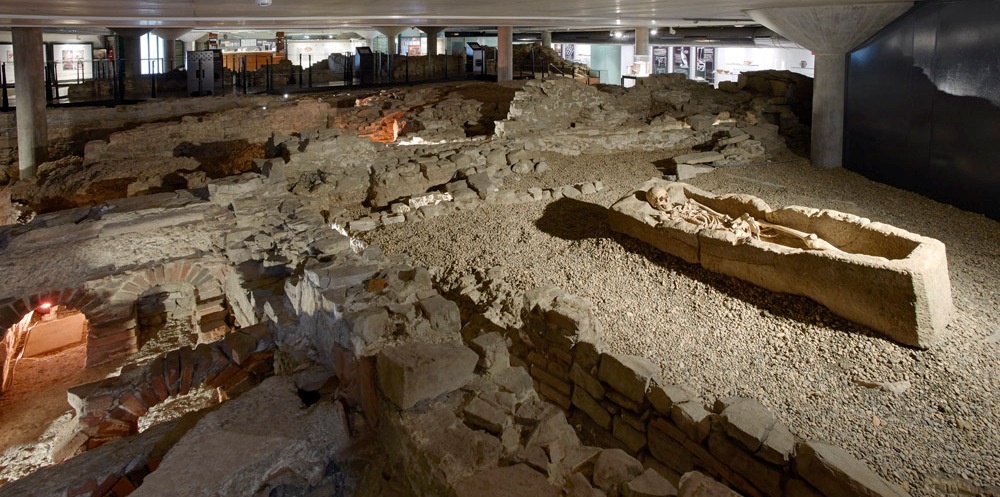
The visitor, turning left from the caldarium, will notice a series of rooms with plinths with remains of paintings. On the right, the procedure for recovering and restoring the pictorial remains of this area of the site is explained. At the end of this corridor, you can see a rectangular room with a very complete hypocaust of columns and with remains of the tubuli laterici used to heat the wall. In the background, a stone sarcophagus and a tomb of flagstones, representative elements of the necropolis that was located in this space in medieval times, are preserved in situ .
The collection
The Museum of the Roman Baths of Campo Valdés is part of the archaeological museums of Gijón, along with the Archaeological-Natural Park of Campa Torres and the Roman Villa of Veranes. In addition to the musealization of the remains, the museum’s collection is made up of a selection of the most representative material remains found in archaeological excavations.
Within the collection we find, on the one hand, the construction materials of the Baths. This includes bricks, tiles, pilae and tubuli laterici, as well as fragments of columns and remains of mouldings. In addition, thanks to the recovery of numerous faunal material, it has been possible to reconstruct the way of eating at the time of construction and use of the Baths. It has also been possible to recover numerous materials related to everyday life, from a fragment of a doll, fragments of glass to kitchen containers and tableware. Special mention should be made of the paintings of the Baths. Fortunately, in some of the rooms they have been preserved in situ. In other cases they have had to be recovered from collapses and have been restored in panels that are exhibited free-standing.
Activities and services
The archaeological museums, including the Roman Baths of Campo Valdés, develop an extensive programme of activities aimed at all audiences, including guided tours for groups (prior reservation), educational programmes, theatre, conferences, conferences on temporary exhibitions, educational programmes and holiday activities aimed at children, adults and families. In addition, this museum has services such as the sale of publications and cloakrooms.
Outreach programs
Within the Museum’s dissemination activities, special attention should be paid to the talks and conferences related to different aspects of the archaeological heritage of Gijón/Xixón, the exhibition of Unique Treasures, as well as dramatised visits, theatre, concerts and dance.
Educational Programs
The Archaeological Museums offer various activities aimed at the educational community of the council of Gijón/Xixón, organized by the Department of Education of the FMCE and UP , which are part of the Didactic Program on Archaeological Heritage and also offer the possibility for the centers to directly arrange the didactic activities
Publications
The study and research on the themes of the Archaeological Museums of Gijón, together with the holding of congresses, has led over the years to the publication of numerous works of various types that are classified by series of a scientific nature (Heritage Series), of a general nature (Monographs) or of an informative nature (Guides and Didactic Publications and Brochures).
OUR IDENTITY
CAMPAIGNS
DISCOVER
HIGHLIGHTS
FEATURED
Error 500 (Server Error)!!1500.That’s an error.There was an error. Please try again later.That’s all we know.
Error 500 (Server Error)!!1500.That’s an error.There was an error. Please try again later.That’s all we know.
Error 500 (Server Error)!!1500.That’s an error.There was an error. Please try again later.That’s all we know.
Error 500 (Server Error)!!1500.That’s an error.There was an error. Please try again later.That’s all we know.
Error 500 (Server Error)!!1500.That’s an error.There was an error. Please try again later.That’s all we know.
Error 500 (Server Error)!!1500.That’s an error.There was an error. Please try again later.That’s all we know.
Error 500 (Server Error)!!1500.That’s an error.There was an error. Please try again later.That’s all we know.
Error 500 (Server Error)!!1500.That’s an error.There was an error. Please try again later.That’s all we know.
Error 500 (Server Error)!!1500.That’s an error.There was an error. Please try again later.That’s all we know.
Error 500 (Server Error)!!1500.That’s an error.There was an error. Please try again later.That’s all we know.
BUSINESS INTELLIGENCE
Error 500 (Server Error)!!1500.That’s an error.There was an error. Please try again later.That’s all we know.
Error 500 (Server Error)!!1500.That’s an error.There was an error. Please try again later.That’s all we know.
Error 500 (Server Error)!!1500.That’s an error.There was an error. Please try again later.That’s all we know.
Error 500 (Server Error)!!1500.That’s an error.There was an error. Please try again later.That’s all we know.
Error 500 (Server Error)!!1500.That’s an error.There was an error. Please try again later.That’s all we know.
Error 500 (Server Error)!!1500.That’s an error.There was an error. Please try again later.That’s all we know.
Error 500 (Server Error)!!1500.That’s an error.There was an error. Please try again later.That’s all we know.
Error 500 (Server Error)!!1500.That’s an error.There was an error. Please try again later.That’s all we know.
Error 500 (Server Error)!!1500.That’s an error.There was an error. Please try again later.That’s all we know.
Error 500 (Server Error)!!1500.That’s an error.There was an error. Please try again later.That’s all we know.