

It is said that Gijón owes the sea to God and the rest to Jovellanos. Jovellanos was a decisive figure in the economic, cultural and urban development of the city where he was born, where he lived and to which he contributed so much to expand urbanistically and economically. Gijón/Xixón grew in the eighteenth and nineteenth centuries, precisely on the proposals put forward by the enlightenment.
Jovellanos Birthplace and San Lorenzo Beach
Our itinerary begins at the birthplace of the most important of Gijón’s personalities: the Birthplace of Jovellanos in Cimavilla. A fifteenth-century palace converted, since 1971, into a museum full of memories of the man who was born there on January 5, 1744: Baltasar Melchor Gaspar María de Jovellanos. The enlightened man, defender of the arts, concerned about the scarce artistic production of Asturias, would have been pleased to see how the dependencies of the family mansion now house works by the most brilliant representatives of Asturian painting and sculpture. Then we visit the annexed chapel of Los Remedios, on the left side of the museum. In it is the tomb of Jovellanos. In the square we pay attention to the hotel establishment on the right. This house was the first headquarters of the Institute of Navigation and Mineralogy founded by Jovellanos to train skilled miners and skilled pilots. The two most important natural resources that Asturias had: the sea and the coal deposits.
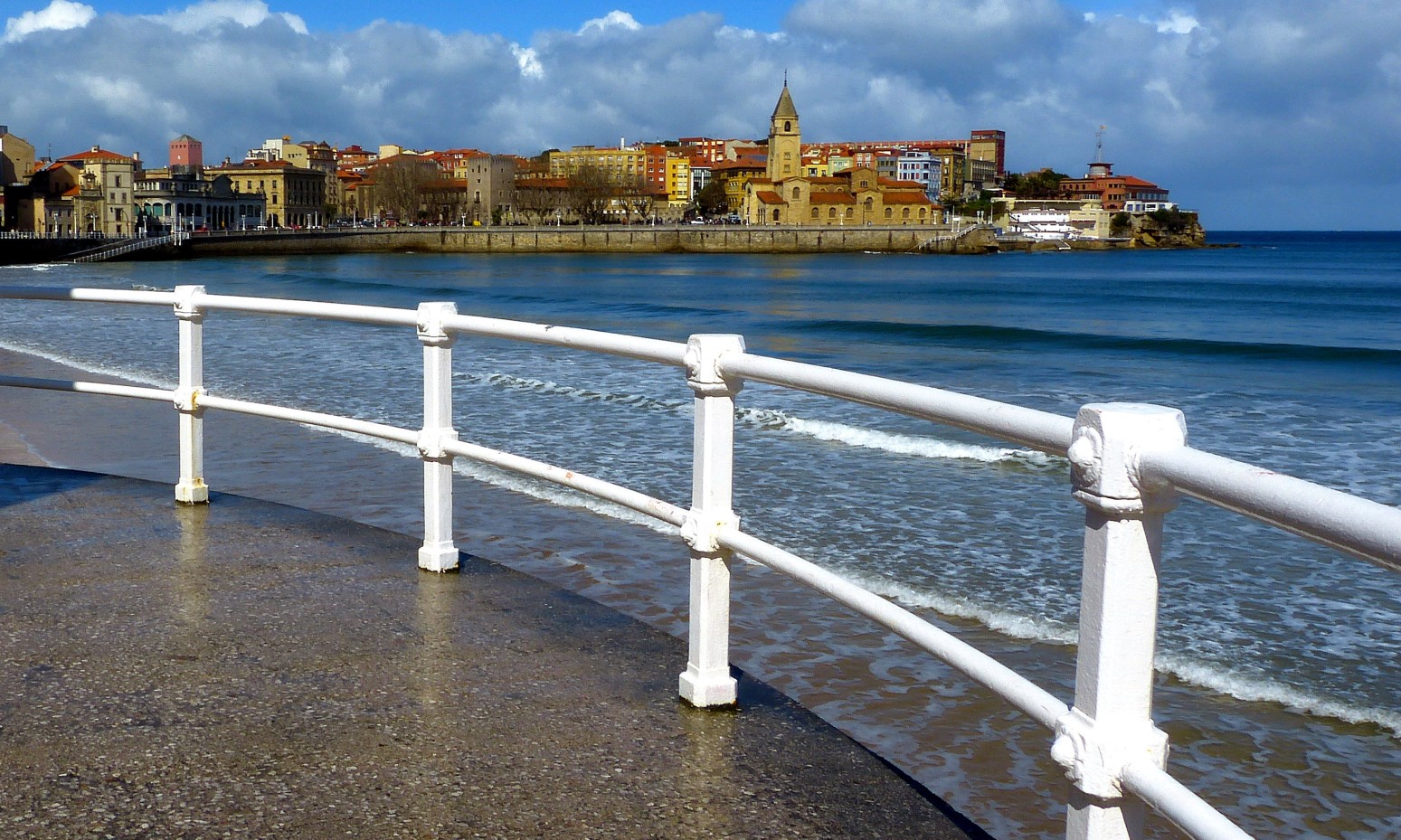
After passing through the Plaza Mayor, with the Town Hall designed by Andrés Coello from the mid-nineteenth century, we continue our tour along the Paseo del Muro, always busy, contemplating the Gijón symbol that is the beautiful beach of San Lorenzo. We do not lose our face to the sea and we see the monumental staircase to access the beach, that is, La Escalerona. This is the name given by the people of Gijón to the staircase built in 1933 by Avelino Díaz and Fernández Omaña in order to solve the problems posed by the massive access to the beach. Baths had become fashionable since the end of the nineteenth century and there were several spas that existed in this area of the beach; only in this area since the rest of the sand, made up of dunes and marshes, slowly began to dry up from 1860, but the retaining wall that we see today was not finished until 1907. Specifically in August 1914 which is when the Piles bridge was inaugurated.
FUN FACT: The visionary Gaspar Melchor de Jovellanos had already been concerned about the demolishing action of the sea and the sand that prevented the growth of the city to the southeast. The enlightened man, who enjoyed frequent walks along the Gijón coast, had proposed to the municipal corporation the construction of the retaining wall and played a decisive part in the section from the back of San Pedro to Capua Street.
Parcheesi Square
Crossing the Nautical Gardens, we take the street that bears the name of Jovellanos. On our left the Plaza del Instituto opens up and on one side we see the Jovellanos Institute. That first building in the upper neighbourhood had become too small and Jovellanos commissioned the project of the definitive Institute to Juan de Villanueva, Chief Architect of the Court. Work began in 1798 although the enlightened man only knew its ground floor. After his death, between 1888 and 1892 the building was completed as we see it today: National Monument since 1975, today it is the headquarters of the Municipal Foundation of Culture, Education and Popular University of the City of Gijón/Xixón and cultural center, which would undoubtedly also be to the liking of the enlightened.
This square is surrounded by a series of buildings of notable interest, the green one on the corner of La Merced street being striking. It is the Casa Berenguer, with a clear Catalan modernist influence, the work of José Graner y Prat from 1902. Next to this house, the basilica of the Sacred Heart of Jesus (the Iglesiona) built between 1918 and 1922 stands out. Designed by the also Catalan Joaquín Rubio i Bellver, the director of the work was Miguel García de la Cruz. Its façade has a great decorative load and is crowned by an immense image of the Sacred Heart (the Santón for the people of Gijón) in Carrara marble and the work of the sculptor Serafín Basora. At about 50 m. high, the Santón is visible from a large part of the city.
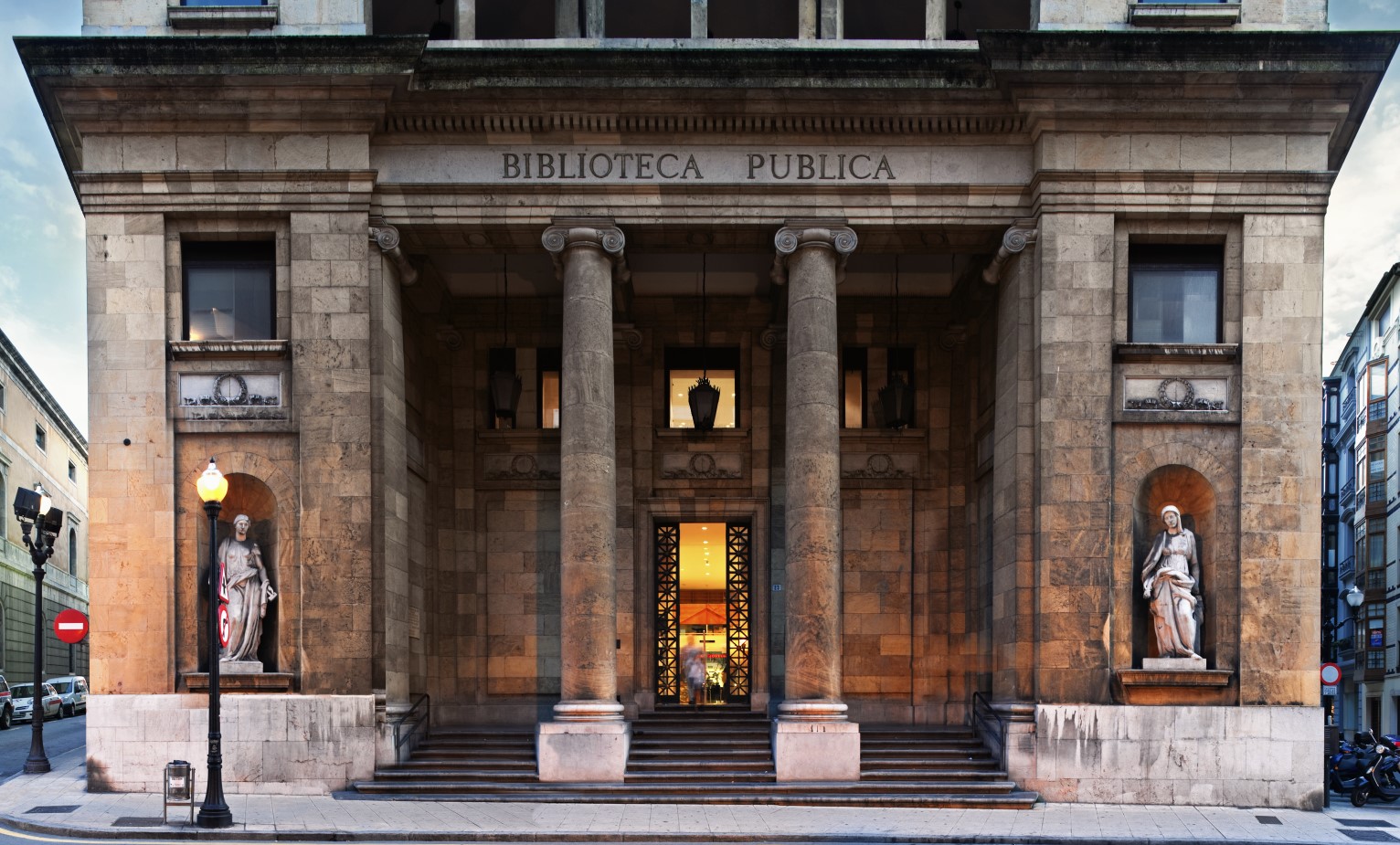
To the right of the Institute and in front of the Iglesiona is the Jovellanos Public Library, formerly the headquarters of the Bank of Spain. It occupies the site of the first Jovellanos Theatre, which disappeared in 1934, which was a pioneer of electric lighting in Spain and whose architect had been Andrés Coello, the same one who built the Town Hall. The current building – a busy and very complete library – was erected according to a project by Luis Menéndez Pidal. We return to the Plaza del Instituto looking at building number 3, in rationalist style, the work of the architects del Busto, father and son. It is considered an emblematic example of Gijón’s rationalism, that is, of the architecture of the early thirties: the architecture of the Republic.
FUN FACT: The Plaza del Instituto is known by the people of Gijón as the Parcheesi, because sixty years ago, when it was designed, it had a square shape with the planters in the corners and with another floral set in the center that gave it the appearance of the classic board game. Today it still retains that unofficial name.
Paseo de Begoña and Plaza Europa
We ascend Calle de La Merced, leaving on our right the old School of Commerce, also designed by Manuel del Busto in 1911, and today recovered as a Cultural Space. It is built on the land that was the orchard and the garden of the Institute and behind it is the Primary School that also, like so many things in Gijón, bears the name of the enlightened one. We arrive at the Paseo de Begoña. It is a natural promontory, which was previously called Alto de Begoña, which in the eighteenth century was converted into an avenue. Over the years it was conditioned until it became a place of leisure, children’s recreation and citizen recreation. To our left we see the Jovellanos Theatre, heir to the old Dindurra, which currently develops an extensive programme under municipal management.
In the background, the slender church of San Lorenzo, built in neo-Gothic style, in 1896, by the architect Luis Bellido. In front of it is a tile and wooden pergola, built in the 1930s and popularly called Los Patos. The primitive one was demolished in the 60s and rebuilt again, with remarkable fidelity to the original, in 1992, when the surroundings were remodeled for the last time. We ascend Calle Covadonga until we reach the Plaza de Europa. This Europeanist space and its surroundings were urbanized when the wall that surrounded the city was demolished in 1877. It is a link between nineteenth-century Gijón and the subsequent growth of the city, the route in and out of Gijón to Oviedo and, naturally, to Castile. It was a space that is still known today as the Puerta la Villa.
We see in these gardens of the Plaza de Europa two very remarkable buildings. One of them is the villa of Ladislao Menéndez, the work of Manuel del Busto from 1907 and, to its left, the Pola Asylum, an old school-nursery for the children of workers. Since 1989, the latter has housed a monographic museum dedicated to the painter Nicanor Piñole (Gijón, 1878-1978) whose rooms are worth visiting. Arriving at the Plaza del Seis de Agosto we are in another Jovellanist space with the statue dedicated to him and with the Mercado del Sur, inaugurated in 1899, when that part of Gijón was precisely the south. On August 6, 1811, he returned to his native town, after an unjust exile of ten years in Mallorca; the city turned to his illustrious son and prepared a popular welcome for him, which is commemorated every year in this same place.
FUN FACT: The name of the square recalls Gijón/Xixón’s recognition of the figure of Jovellanos. At the end of the nineteenth century, it was decided to dedicate this space to the memory of Jovellanos, and a statue was commissioned from the sculptor Manuel Fuxá, the same author as Columbus, in Barcelona. The statue of the enlightened man was inaugurated in 1891 at the same time as the one dedicated to Pelayo in the Plaza del Marqués.
From Los Moros to Corrida Street
We now take the commercial Calle Los Moros, one of the busiest in the city, in which there are many buildings from the early twentieth century, representative of the economic take-off of Gijón at the time, when a powerful bourgeoisie began to occupy the streets of the urban centre. The streets of Los Moros, Corrida and Instituto, in a north-south direction, together with other transversal streets, are part of the Improvement Plan that Jovellanos proposed in 1782. It was undoubtedly a pioneering plan in terms of urban reforms and whose ideas served as the basis for the growth of the city in the following century. At the end of Los Moros Street, on the corner of Munuza, stands the Banco de Gijón building, built in 1902 by the architect Luis Bellido. With a luxurious façade, with a large load of decorative elements, its French-style attic roof is striking, as well as the small dome that crowns the clock.
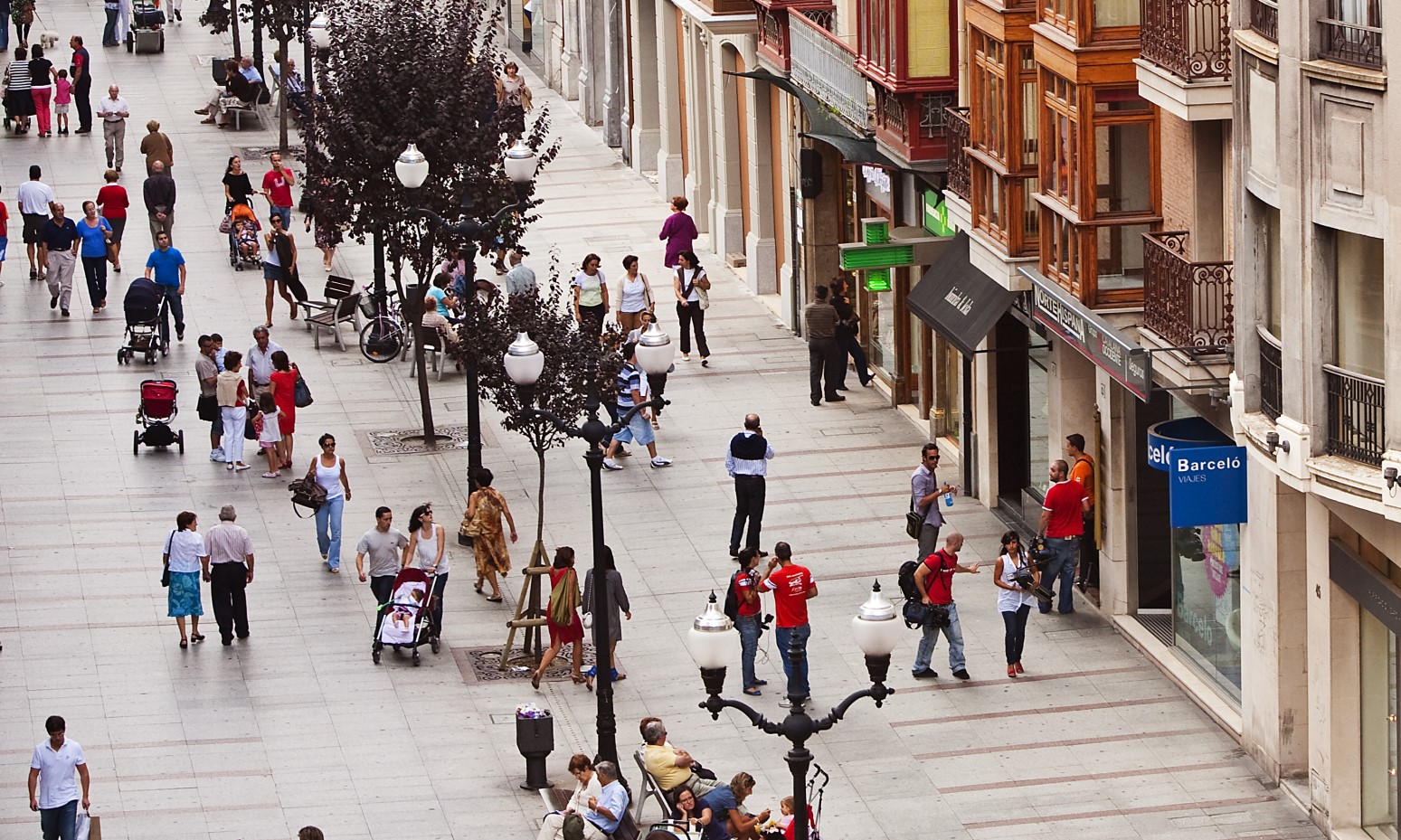
We continue along Calle Corrida, the most representative street in Gijón/Xixón. It is already mentioned at the beginning of the seventeenth century, with the name of Calle Ancha de la Cruz de la Huelga; a term that refers to religious connotations and the strike, that is, leisure and walking. When the street was widened, it was renamed Calle Corrida, as it left the Arco del Infante in the Plaza del Seis de Agosto and ended at the Muelle, all in a row. This section of the street we walked along was a typical boulevard in the Parisian style, with lampposts, trees, clocks, several hotel establishments and busy cafes. Leisure and commerce have always been the two activities of this street, the most traditional place for walking and a street that, let’s not forget, linked the old coal port (today the Marina) with the exits from the city to Oviedo and to the mining areas. And vice versa.
FUN FACT: The Asturian painter Evaristo Valle lived and died in the aforementioned Banco de Gijón building, which has an interesting monographic museum on the La Redonda estate, in Somió.