
7º Principle
“Water is the beginning of everything. Or not?”
About 2,000 years ago, after the end of the Asturcantabrian wars, the Roman Empire settled in what is now the council of Gijón/Xixón. They cared, above all, to leave us a lot of archaeological remains for our delight: the Campo Valdés hot springs, the wall, the town of Veranes… Well, that and the cider. Oh no, they didn’t bring the cider. In fact, there are those who say that they were more of wine… However, we have observed that the people of the Antiqvi Mores Cultural Association, who are more Roman than the Romans, drink cider at esgaya, so they love it.
Yes, here we are Asturians and we are also Romans, but above all we are cider makers. Water gives us life and feeds nature, but cider feeds our spirit. Can you imagine the Roman legionaries pouring culinos among the Asturian people? That’s why we like it so much folixa.


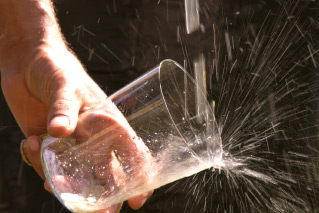
A culin?
Cider, to be tasted, requires an entire liturgy. We do not expect you to know all the rules, only the strictly basic ones: it must be poured correctly so that espalme and awaken its flavors and aromas (you don’t have to do it, the cider house staff takes care of it); It is served in rounds and should be drunk immediately and in one go. And remember: it is not drunk as if it were wine or beer. You don’t want to commit such sacrilege!
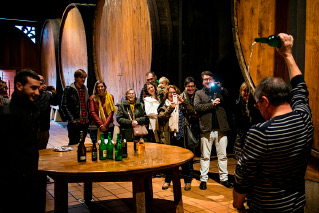
The cisterns
In the surroundings of Gijón/Xixón you can find numerous cisterns, which is where the cider is made. We invite you to get to know them on a guided tour, discover the production process and enjoy a tasting. Many complete the visit with an espicha, a traditional informal meal with cheese, tortilla, chorizo in cider and other home-style delicacies.
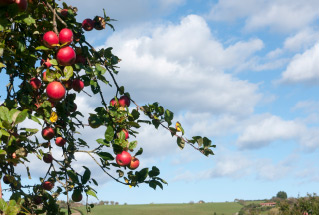
Pumaraes and apples
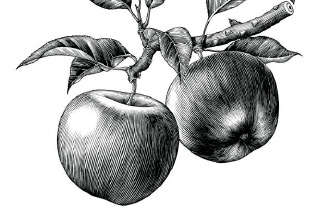
Did you know that at Asturias we have more than 2,000 varieties of native apples? They have beautiful names: blancana, raxao, theoretical, perezosa, prieta, xuanina, ernestina, coloradona…
The apple tree plantation is called pumarada. If you take a walk through the rural surroundings of Gijón/Xixón, it will not be difficult for you to find meadows full of apple trees and their unmistakable smell.
The Campa Torres
Did you know that at Asturias we have more than 2,000 varieties of native apples? They have beautiful names: blancana, raxao, theoretical, perezosa, prieta, xuanina, ernestina, coloradona…
The apple tree plantation is called pumarada. If you take a walk through the rural surroundings of Gijón/Xixón, it will not be difficult for you to find meadows full of apple trees and their unmistakable smell.
The origin of cider
Already in the 1st century BC. C. Strabo spoke of a drink consumed by the Asturians called zythos. The abundance of apple and the absence of grapes and cereals rule out other drinks and make it very likely that it was referring to our cider. The word cider comes from Greek sikera, and from there sizra.
Cimavilla
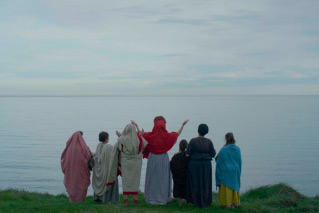
After the arrival of Rome, the inhabitants of this territory settled on the peninsula that we today call Cimavilla. In this picturesque neighborhood you can see the ancient Roman wall and visit the Campo Valdés Roman Baths Museum, located next to San Lorenzo beach, the church of San Pedro and the statue of Caesar Augustus.
Roman Villa of Veranes
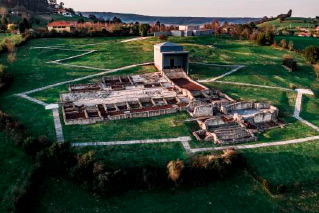
A few kilometers from the city we find a late Roman villa that is today a museum. It is a large residential and agricultural complex where a valuable mosaic is preserved. The wealthy Romans of that time also made their own mansions, of course.